Keeping the Keys: West African Balafon Masters in America Are Done Letting Others Tell Their Story
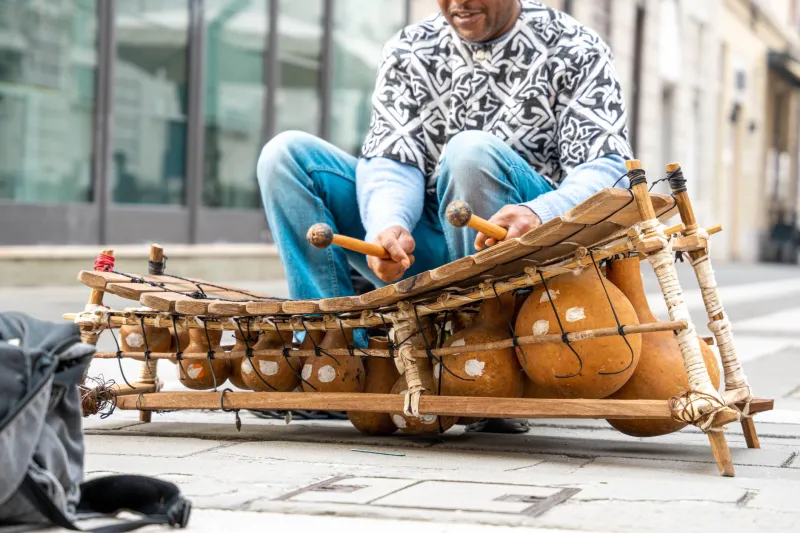
There's a moment Mamadou Kouyaté describes that a lot of people in his community know well. You're performing at a cultural festival somewhere in the American Midwest, and someone in the audience — well-meaning, genuinely curious — walks up afterward and says something like, "That's basically an African xylophone, right?" You smile. You explain. You do it again at the next show. And the one after that.
"After twenty years, the explaining doesn't get easier," says Kouyaté, a Guinean-born balafon player who has been based in the US for over two decades and now runs a cultural education program in the Atlanta area. "What gets harder is watching the instrument you grew up with, the instrument your grandfather played, get reduced to a sound effect or a trend — and feeling like you have no control over that story."
That tension — between sharing and surrendering, between visibility and misrepresentation — sits at the heart of a growing conversation among West African musicians and cultural workers living in the United States. As the balafon finds itself increasingly in demand, from recording studios and wellness apps to school classrooms and corporate retreats, the people with the deepest claim to it are asking a pointed question: who gets to say what this instrument means?
Arrival Stories
The balafon's presence in America didn't start with a trend. It arrived in suitcases, in memory, in the hands of musicians who left Guinea, Mali, Burkina Faso, and Senegal carrying their craft with them the way others carry family photographs.
Fatoumata Diabaté came to the US in the early 2000s, settling in Minneapolis after years of performing across West Africa and Europe. She brought two balafons with her — one for performing, one as a backup — and spent her first years here playing for West African diaspora communities at weddings, naming ceremonies, and cultural gatherings. "Those were the gigs that kept the instrument alive for me," she says. "Not the world music festivals. The community events. The places where people already understood what they were hearing."
That distinction matters. For many balafon players who immigrated to the US, the instrument's meaning was never abstract. It was tied to specific ceremonies, specific lineages, specific social functions within Mande and Senufo cultures. When that context gets stripped away — when the balafon becomes just a "cool sound" or an "exotic texture" in someone else's production — something real is lost.
"The instrument carries knowledge," says Sékou Bah, a performer and educator based in the Washington, D.C. area. "Every tuning system, every rhythm pattern — these are not just music. They are information. They are history. When someone samples a balafon loop without understanding any of that, they're not just borrowing a sound. They're erasing a library."
The Commodification Problem
No one is arguing that the balafon shouldn't be heard outside of West Africa. The musicians we spoke to were unanimous on that point. Cultural exchange, when it's done right, can be genuinely meaningful. The problem, they say, is when exchange becomes extraction.
Over the past several years, the balafon has shown up in contexts that would have been hard to predict a decade ago — spa playlists, mindfulness apps, corporate wellness programming, and high-end music therapy practices. In many of these settings, the instrument is presented in ways that are vague at best and actively misleading at worst. "African healing music" is a common descriptor, broad enough to mean almost nothing and specific enough to imply a kind of mystical authenticity that sells.
"I've seen my own recordings used in apps without my permission," says Diabaté. "And when I've looked into it, the people running these platforms had no idea where the music came from. They just found it somewhere online and thought it sounded right for their brand."
The legal landscape for musicians in this position is murky. Copyright protections exist, but enforcing them across digital platforms — especially for independent artists without major label backing — is expensive and exhausting. And the problem isn't always about outright theft. Sometimes it's subtler: a producer who reaches out asking for "authentic African vibes" and offers payment, but wants full creative control and no credit. Or a school curriculum that teaches the balafon as a generic "African instrument" without naming a single tradition, player, or community.
"Anonymizing the instrument is its own kind of erasure," says Bah. "You can pay someone and still strip their culture of meaning."
Building Something Different
Frustration is real, but so is action. Across the country, balafon players and cultural workers are building structures — formal and informal — to change how the instrument gets presented and who profits from that presentation.
Kouyaté's Atlanta program, which combines performance instruction with cultural history, is one example. Students don't just learn to play; they learn where specific tuning systems come from, what ceremonies certain rhythms belong to, and who the master players are in the living tradition. "I want people to walk away knowing names," he says. "Knowing places. Knowing that this instrument has a genealogy."
In New York, a collective of West African musicians has started hosting community conversations — part workshop, part open forum — where they invite producers, educators, and cultural institutions to talk about collaboration in more honest terms. The events are deliberately low-key, held in community spaces rather than concert halls, and the conversations can get uncomfortable. That's kind of the point.
"We're not trying to gatekeep," says one of the collective's organizers, who asked not to be named. "We're trying to slow things down long enough for people to ask better questions. Like: have you talked to anyone from this tradition? Are you crediting your sources? Are the people you're learning from being compensated fairly?"
Online, a new generation of balafon players is using social media not just for performance clips but for context — explaining tuning systems in short videos, naming their teachers, discussing the ceremonial functions of specific pieces. It's educational content that also functions as a kind of claim-staking: this instrument has a living, specific, documented tradition, and we are part of it.
What Authentic Sharing Actually Looks Like
The musicians we spoke to weren't interested in drawing hard lines around who can engage with the balafon. What they want is something more nuanced: engagement that comes with accountability.
That means crediting sources — specifically, not generically. It means compensating the musicians who teach, consult, and perform. It means being honest about what you know and what you don't, and being willing to learn in ways that require actual effort. And it means understanding that the balafon is not a symbol or a vibe. It's a living practice, maintained by real people with real names and real stakes in how it gets represented.
"I love that Americans are curious about this instrument," says Diabaté. "I want that curiosity to go somewhere real. Not just to a playlist or a sample pack, but to a person. To a tradition. To a community that's been here, doing this work, for a long time."
Kouyaté puts it more simply. "Come find us," he says. "We're not hard to find. We're right here."
And they are — teaching, performing, building, and making sure that when the balafon's story gets told in America, it gets told right.