Wooden Keys, Big Screen Feelings: How the Balafon Is Rewriting the Rules of Indie Film Scoring
There's a scene in Dara Mensah's debut short film Red Laterite Road where a character sits alone at a bus stop, watching the sun drop behind a line of dusty trees. No dialogue. No dramatic swell of violins. Just the low, resonant hum of a balafon, its gourd resonators buzzing like something alive underneath the melody. Audiences at the Chicago International Film Festival didn't just notice it — they couldn't stop talking about it.
"People kept coming up to me after screenings asking what that sound was," Mensah recalls. "Not in a confused way. In a hungry way. Like they'd heard something they didn't know they were missing."
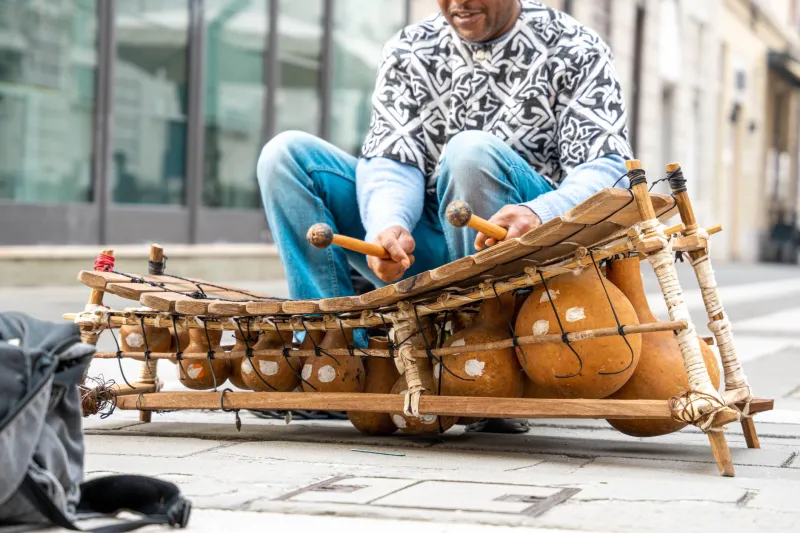
That hunger is showing up in festival circuits, streaming platforms, and indie production houses all over the country right now. The balafon — a West African instrument with roots stretching back over a thousand years, built from wooden keys and dried gourds — is having a serious moment in American independent film. And the reasons why are more layered than you might think.
The Budget Myth That's Actually a Feature
Let's be honest: one of the first things indie filmmakers deal with is money, or the lack of it. Hiring a full orchestral ensemble to score your film is a dream for most directors working outside the studio system. Session musicians, studio time, licensing — it adds up fast.
But here's where the conversation gets interesting. Directors who've turned to traditional African instrumentation aren't doing it as a compromise. Many of them started there on purpose.
"I had a budget, and I could have used it on a standard score," says Portland-based filmmaker Kezia Osei, whose documentary Saltwater Roots premiered on a major streaming platform earlier this year. "But I kept asking myself — why does every film about diaspora identity sound like it was scored by someone who's never left Europe? The balafon gave me something true."
Osei worked with a Guinean musician based in Atlanta to build the film's entire sonic landscape around the balafon and a handful of complementary percussion instruments. The result was a score that critics described as "emotionally immediate" and "unexpectedly intimate" — words you don't often see attached to documentary film music.
Something the Orchestra Can't Do
The balafon has a tonal quality that's genuinely hard to replicate. Its attack is sharp and percussive, but the sustain — amplified and colored by those resonating gourds — carries warmth in a way that synthesized strings or piano simply don't. For filmmakers working in naturalistic or emotionally raw territory, that combination is almost unfair in how effective it is.
New York director Marcus Ibe, who's been building a reputation on the festival circuit with intimate character studies, put it plainly: "The balafon doesn't lie. You can feel when it's real. Audiences have been trained by decades of Hollywood scoring to tune out certain sounds. They don't tune this out."
Ibe's latest project used a balafon-led score to underscore a story about a Malian immigrant navigating New York's outer boroughs. He spent three weeks workshopping the music with the composer, a Bamako-born musician now living in Brooklyn, before a single frame was edited. The score came first. The cut followed the sound.
That kind of process — letting the instrument lead — is becoming more common among a generation of filmmakers who grew up consuming world music as naturally as they consumed hip-hop or indie rock.
Streaming Platforms Are Paying Attention
It's not just the filmmakers. The platforms distributing this content are starting to notice that audiences respond differently to these scores. Completion rates, rewatch behavior, and social sharing patterns are telling a story that analytics teams find hard to ignore.
One acquisitions editor at a mid-sized streaming service, speaking without attribution, described a recent wave of submissions featuring African instrumentation as "punching above their production weight." The emotional engagement metrics on several of these titles outperformed comparable films with more conventionally produced scores.
"There's something about the authenticity of the sound that keeps people present," she said. "It's not exotic for its own sake. When it's done right, it just fits the story in a way that feels inevitable."
That phrase — done right — matters. The directors and composers making this work aren't treating the balafon as a shortcut to cultural flavor. The most successful collaborations have involved deep creative partnerships between filmmakers and West African musicians who understand both the instrument's ceremonial roots and its contemporary expressive range.
A New Creative Pipeline
What's emerging is something bigger than a trend. It looks more like a pipeline — a growing network of West African musicians living in US cities like Atlanta, Minneapolis, New York, and Washington D.C., who are building careers at the intersection of traditional practice and contemporary film composition.
Many of these musicians studied under masters in Guinea, Mali, Senegal, or Burkina Faso before relocating. They bring not just technical skill but an understanding of the balafon's role in storytelling — because in West African tradition, the instrument has always been tied to narrative. It accompanied griots. It marked ceremonies. It told community stories across generations.
For indie film, that lineage is gold.
"People ask me if I feel like I'm compromising the instrument by putting it in a film score," says Seydou Kouyaté, a balafon player and composer based in Minneapolis who has scored four independent films in the past two years. "I tell them the balafon has always been in service of a story. That's literally what it was made for. Film is just a new room."
Where This Goes Next
The conversation is only getting louder. Film schools are starting to include world music composition in their curriculum. Festivals are programming panels on decolonizing the film score. And a handful of music supervisors who work across the indie ecosystem are actively building rosters of West African instrumentalists to pitch to directors during pre-production.
For anyone paying attention to the sounds coming out of American independent cinema right now, the balafon's rise isn't a surprise. It's an arrival.
The instrument has been here — in communities, in classrooms, in living rooms — for years. The screens are just finally catching up.